Racing Smash 3D
- 4.7
- Rating
- 10.00M
- Installs
- Free
- Price

 Analysis by App-foxy
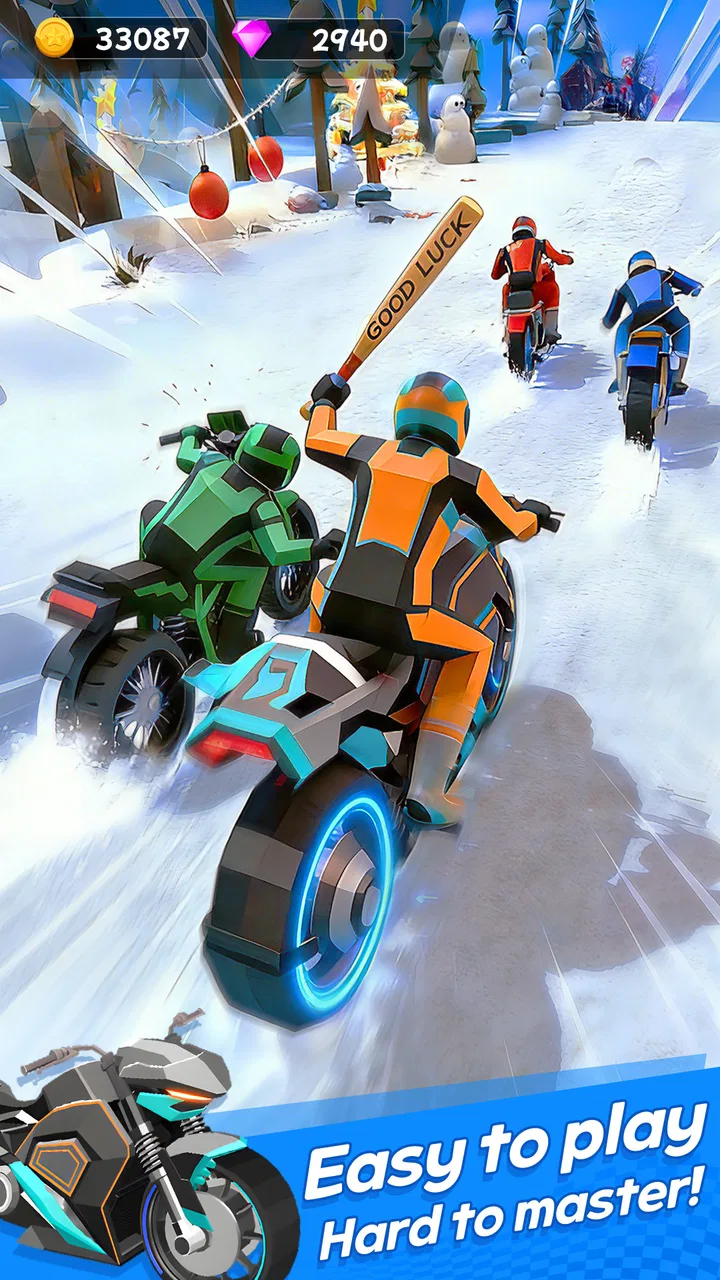
I went into Racing Smash 3D expecting a quick sports game built around speed, but its appeal comes from the way it mixes racing with direct physical confrontation. The first action is simple: move through a race, react to what is ahead, and use the moment-to-moment contact to keep control. That combination gives each attempt a sharper edge than a conventional lane-based racer, because progress is not only about reaching the finish. It is also about surviving the interruptions that happen along the way.
That makes this a useful choice when I want something I can understand immediately without committing to a long campaign. It is a free game in the Sports category, developed by MY DNS BD, and its Everyone age rating makes it approachable for a broad audience. At the same time, the action is intentionally compact and repetitive, so it works best for players who enjoy short bursts of racing and fighting rather than a detailed simulation or a deep management game.
How the first action turns into a playable routine
The opening moments are important because they establish the whole relationship between the player and the game. I do not need a long explanation to understand the basic goal: keep moving, deal with obstacles or opponents, and make it farther than the previous attempt. That low barrier is one of its strongest qualities. I can pick it up while waiting for an appointment, play for a little while, and stop without feeling that I have abandoned a complicated story.
You May Also Like

 Google Keep - Notes and lists
Google Keep’s Quiet Growth Shows the Appeal of Simpler Notes
As mobile work gets busier, Google Keep keeps winning a simple contest: capture a thought quickly, find it later, and get on with the day.

 Blood Strike: 2.5 Anniversary
Blood Strike’s Loadouts Turn Every Drop Into a Tactical Gamble
A close look at Blood Strike’s custom loadouts: how fast access to signature weapons reshapes its battle royale rhythm, rewards preparation, and narrows the gap between fights.

 Pandora - Music & Podcasts
Pandora’s Music Is Easy to Start, but Harder to Recover
Pandora’s strength is its low-effort path from a seed to a station. Its weak spot is how much confidence it asks you to place in connection, setup, and quiet recovery.

 8 Ball Pool
 Is Built on Rivalries, Rematches, and Routine
A close look at the rivalries, rematches, shared routines, and unanswered safety questions that turn a quick pool match into a persistent mobile community.

 Samsung Music
’s Quiet Strength Is Playing What You Already Own
Its reach comes less from spectacle than from dependable access to a personal library. That simplicity is both the app’s strongest retention engine and its ceiling.

 AccuWeather: Weather Radar
AccuWeather Review: A Quick, Clear Forecast for Everyday Decisions
For everyday plans, the best forecast is the one you can understand quickly. AccuWeather makes rain timing, radar, and local conditions easy to act on, with a few trade-offs.
More From Our News Desk



The racing side gives the game its forward pressure. Movement is not passive, because every second spent on the track creates another opportunity to lose position or make a useful attack. The fighting side gives the controls a purpose beyond steering. When I make contact successfully, the result feels more meaningful than simply changing direction. I am not just following a route; I am trying to create a clean path through a crowded, aggressive course.
What I like about this setup is that it creates an immediate decision even when the controls remain accessible. I can focus on avoiding trouble and preserving my run, or I can play more aggressively and try to remove the threat in front of me. The safer approach is easier to understand, but it can also feel slower and less satisfying. The aggressive approach offers a stronger payoff when it works, yet mistakes become more costly because a failed collision can interrupt the run.
This is also where the game differs from a usual casual racing alternative. A simple racer generally asks me to concentrate on direction, timing, and the finish line. Here, the track is also a space for confrontation. That means I am reading the road and the opponent at the same time. It is a small distinction, but it changes the mental rhythm: I am not merely asking where to go next; I am asking whether the next interaction should be avoided or challenged.
For a new player, I recommend starting conservatively. The temptation is to attack every target because the fighting element is the most noticeable part of the concept. In practice, learning when not to engage is just as useful. A clean run often depends on keeping enough control to respond to the next situation, rather than spending every opportunity on an immediate clash. This is one of the first non-obvious lessons I took from repeated attempts.
The feedback rhythm keeps short attempts moving
The game’s feedback loop is straightforward: I act, the race responds, I see whether that decision helped, and then I adjust during the next moment. Successful contact gives a sense of progress, while a mistake quickly reminds me that speed without control is not enough. Because the result of an action is easy to read, I do not have to study complicated menus or statistics to understand why an attempt went well or badly.
That clarity is valuable on a phone. A game like this has to communicate quickly, especially when I am playing with only a few minutes available. The strongest moments are the ones where an action produces an immediate change in the flow of the race. I feel that I have earned space, avoided a problem, or recovered from a dangerous position. Those small reactions are what make another attempt feel worthwhile.
However, the same simplicity can become a limitation for players who want extensive variety. The core feedback is based on movement, collision, survival, and progress. If those actions are not satisfying to you, there is not a large layer of strategy waiting underneath to rescue the experience. I would not choose this over a full racing simulator, a story-driven sports game, or a competitive title with detailed tuning and long-term mastery.
My most useful adjustment was to stop treating every opponent as an invitation to attack. The race becomes easier to read when I divide the track into two questions: can I keep my line, and will contact improve my position? If the answer to the second question is unclear, preserving movement is usually the better choice. This approach makes the action feel less random because I am responding to the situation instead of reacting to every visual threat.
That habit also makes the game more suitable for casual players. Someone who has never played a racing-and-fighting hybrid can understand the idea quickly, while a more experienced player can still find satisfaction in refining timing and choosing better moments to engage. The depth is not built from a large number of systems; it comes from making better decisions inside a small loop.
Why the reward is strongest after a controlled run
The reward in Racing Smash 3D is not only the fact that a run continues. It is the feeling that a difficult section has been handled more cleanly than before. When I avoid an unnecessary collision, recover from a poor approach, or make a useful attack without losing control, the result feels earned. The game encourages me to measure improvement through better execution rather than through a complicated explanation of what I should have done.
This is where the racing and fighting elements support each other. Racing creates the goal of moving forward, while fighting creates moments that test whether I can maintain that progress. A successful action is satisfying because it solves an immediate problem and protects the rest of the run. The reward arrives as continued momentum, which is a good fit for short mobile sessions.
There is a practical use case here. If I have a brief break during the day, I can play one attempt without needing to remember a story, rebuild a team, or wait for a long match to finish. The game gives me a clear starting point and a clear reason to try again. It is especially comfortable for players who like arcade-style repetition, where the goal is to improve the next run rather than complete a large checklist.
The free entry point also helps with that casual role. Anyone can try the basic experience without paying first, while optional in-app purchases range from under a dollar to amounts approaching fifty dollars per item. That range is worth keeping in mind before spending. I would treat purchases as optional conveniences rather than part of the reason to install the game, and I would decide on a personal limit before browsing any paid items.
That advice is particularly important for a game built around repeated attempts. When a run ends quickly, the desire to start again can make any available purchase feel more urgent than it really is. I prefer to judge whether my decisions are improving before considering spending. If I am still losing because I rush into contact or fail to read the route, paying will not fix the underlying problem. Better timing is the first upgrade I would pursue, even if that upgrade is only in my own play.
The reset is part of the appeal, not just a failure screen
Every attempt eventually reaches a reset point, and the game benefits from making that restart feel natural. I can look at what happened, identify one mistake, and immediately test a different approach. The reset is not connected to a long recovery process, which keeps the action focused on learning the next run. That is the main reason I found myself starting again: the previous attempt usually left one clear question unanswered.
Did I attack too early? Did I protect my line when I should have taken a risk? Was the collision unavoidable, or did I create it by moving without enough space? These questions give the restart a purpose. They turn repetition into a small experiment rather than an empty loop. For me, the best sessions are not the longest ones; they are the sessions where each attempt changes one decision and produces a clearer result.
Still, not everyone will enjoy this structure. Players who need a strong narrative, a large collection of modes, or a sense of permanent progression may find the reset cycle thin. The game is built around immediate action and another try, not around a broad sports career. It is also less suitable for someone looking for realistic vehicle handling or a calm driving experience, because the fighting component deliberately pushes the action toward arcade-style disruption.
One useful way to play is to give each short session a single focus. I might spend one attempt prioritizing clean movement, then use the next to test more confident attacks. This prevents the game from becoming a blur of reflexes and makes the feedback easier to understand. It also helps answer an important question for new users: whether the frustration comes from the game’s design or from one habit in my own approach.
Device compatibility is fairly approachable for an older Android audience, since the game supports Android 7.0 and later. Its current version is 2.0.108, so players using compatible devices can approach it as a current mobile release rather than an abandoned experiment. I would still expect the experience to depend on the phone itself, especially when quick reactions matter, but the operating-system requirement is not unusually demanding.
Where it sits among mobile sports games
Compared with ordinary racing games, this one is more confrontational and less interested in presenting a pure driving challenge. Compared with fighting games, it places the action inside forward movement instead of a fixed arena. That middle ground is its identity. If I want a quick mix of racing pressure and direct clashes, it offers a more focused option than switching between two separate genres.
The trade-off is that it does not replace either type of specialist game. A dedicated racer will usually be better for players who care about precise handling, track technique, and vehicle detail. A dedicated fighting game will usually offer more control over attacks, defense, characters, and match structure. Racing Smash 3D is instead for the player who enjoys the instant readability of both but wants them compressed into one mobile loop.
The public response suggests that this formula has reached a substantial audience: it holds a 4.7 average from over two hundred thousand ratings and has passed ten million installs. Those figures do not decide whether I will enjoy it, but they do make the game easier to approach as an established casual choice rather than an obscure download. The developer, MY DNS BD, has built the experience around a concept that is simple to explain and quick to test.
I would recommend it to someone who likes arcade sports games, enjoys restarting after a near miss, and wants action that can be understood within a few minutes. It is also a good fit for players who prefer experimenting with timing instead of learning a complex control scheme. The Everyone rating makes it broadly approachable, although the repetitive action may still be better suited to people who enjoy quick competitive pressure.
I would skip it if my priority were realism, a deep progression system, a story campaign, or long sessions with many different strategic layers. I would also look elsewhere if repeated resets feel discouraging rather than motivating. The game’s value depends on whether the action itself is enough to make me try again. Without that attraction, the compact structure can feel more limited than focused.
My verdict on the complete action loop
After spending time with it, I see Racing Smash 3D as a deliberately direct game: take the first action, read the response, enjoy the reward of a good decision, and reset with one adjustment in mind. Its best quality is the way racing and fighting give each other urgency. Forward movement makes every clash matter, while the clash prevents the race from becoming a routine exercise in steering.
I especially appreciate that the game can fit into ordinary gaps in the day. A short session has a clear purpose, and a restart does not demand much preparation. The most satisfying progress comes from learning restraint: not every opponent needs to be challenged, and not every opening is worth taking. That small tactical layer gives the simple controls more personality than the store summary alone would suggest.
There are limits, including the repetitive nature of the core loop and the fact that it cannot provide the depth of a specialist racing or fighting game. Optional purchases also mean I would play with a spending boundary in mind, particularly because repeated attempts can encourage impulsive decisions. Even so, the free starting point makes it easy to judge the central action without a commitment.
My recommendation is simple: install it if you want a fast arcade blend of racing and fighting that rewards immediate decisions and makes another attempt feel natural. Skip it if you are searching for simulation, storytelling, or extensive customization. For the right player, its compact loop is not a weakness; it is exactly what makes one more race so easy to begin.
FAQs for Racing Smash 3D
01What is Racing Smash 3D about?
Racing Smash 3D is an adrenaline-pumping motorcycle racing game where players navigate through a variety of tracks while smashing obstacles and opponents. The game combines high-speed racing with combat elements, offering a thrilling experience with its dynamic graphics and engaging gameplay mechanics.
02What are the main features of Racing Smash 3D?
Racing Smash 3D features intense racing action, a wide range of motorcycles to unlock, and various levels with unique challenges. Players can perform stunts, use weapons to eliminate opponents, and enjoy stunning 3D graphics. The game also includes leaderboards and achievements to enhance competitive play.
03Is Racing Smash 3D free to play?
Yes, Racing Smash 3D is free to download and play. However, it contains in-app purchases that allow players to buy additional items, such as new bikes and upgrades. These purchases can provide advantages but are not necessary to enjoy or progress through the game.
04What devices are compatible with Racing Smash 3D?
Racing Smash 3D is available for both Android and iOS devices. Players should ensure their device meets the minimum system requirements, such as having a compatible operating system version and sufficient storage space, to run the game smoothly without performance issues.
05Are there any tips for beginners in Racing Smash 3D?
Beginners should focus on mastering the controls and timing to avoid obstacles and effectively use weapons. It's advisable to start with easier tracks to develop skills and gradually progress to more challenging levels. Collecting coins and bonuses will help unlock better motorcycles, enhancing gameplay.
Pros
- Addictive and fun gameplay mechanics.
- Smooth controls enhance racing experience.
- Variety of motorcycles to unlock.
- Engaging graphics and sound effects.
- Frequent updates with new content.
Cons
- Contains ads that can interrupt gameplay.
- Limited customization options for bikes.
- In-app purchases can be pricey.
- Occasional lag on older devices.
- Repetitive tracks may reduce replay value.

Racing Smash 3D
Gallery